
Less Maintenance Doesn’t Mean No Maintenance
Quiet. Smooth. Powerful.
That’s how most people describe electric vehicles.
Many people would also describe them as maintenance-free.
That’s one of the biggest misconceptions surrounding EV ownership.
While electric vehicles eliminate oil changes, spark plugs, fuel filters, and several traditional engine services, they still require scheduled maintenance and regular inspections to maximize safety, reliability, efficiency, and long-term performance.
Understanding what your electric vehicle actually needs—and when it needs it—is one of the best ways to protect your investment.
Whether you own a BMW i3, BMW i4, BMW i5, BMW i7, BMW iX, MINI Cooper Electric, Tesla Model S, Model 3, Model X, Model Y, Porsche Taycan, Mercedes-Benz EQ, Audi e-tron, or another electric vehicle, following the manufacturer’s recommended maintenance schedule helps keep your vehicle operating safely, efficiently, and reliably for years to come.
What Maintenance Does an Electric Vehicle Actually Need?
Although electric vehicles eliminate many traditional maintenance items, they still require scheduled maintenance and regular inspections to remain safe, reliable, and efficient.
One of the biggest concerns for new EV owners is battery replacement. Fortunately, that’s rarely the first maintenance expense. Instead, most electric vehicles first require scheduled maintenance for wear items such as tires, brake fluid, cabin air filters, and the 12-volt battery.
Understanding these services helps explain why electric vehicles require less maintenance—not no maintenance.
Electric Vehicle Maintenance Checklist
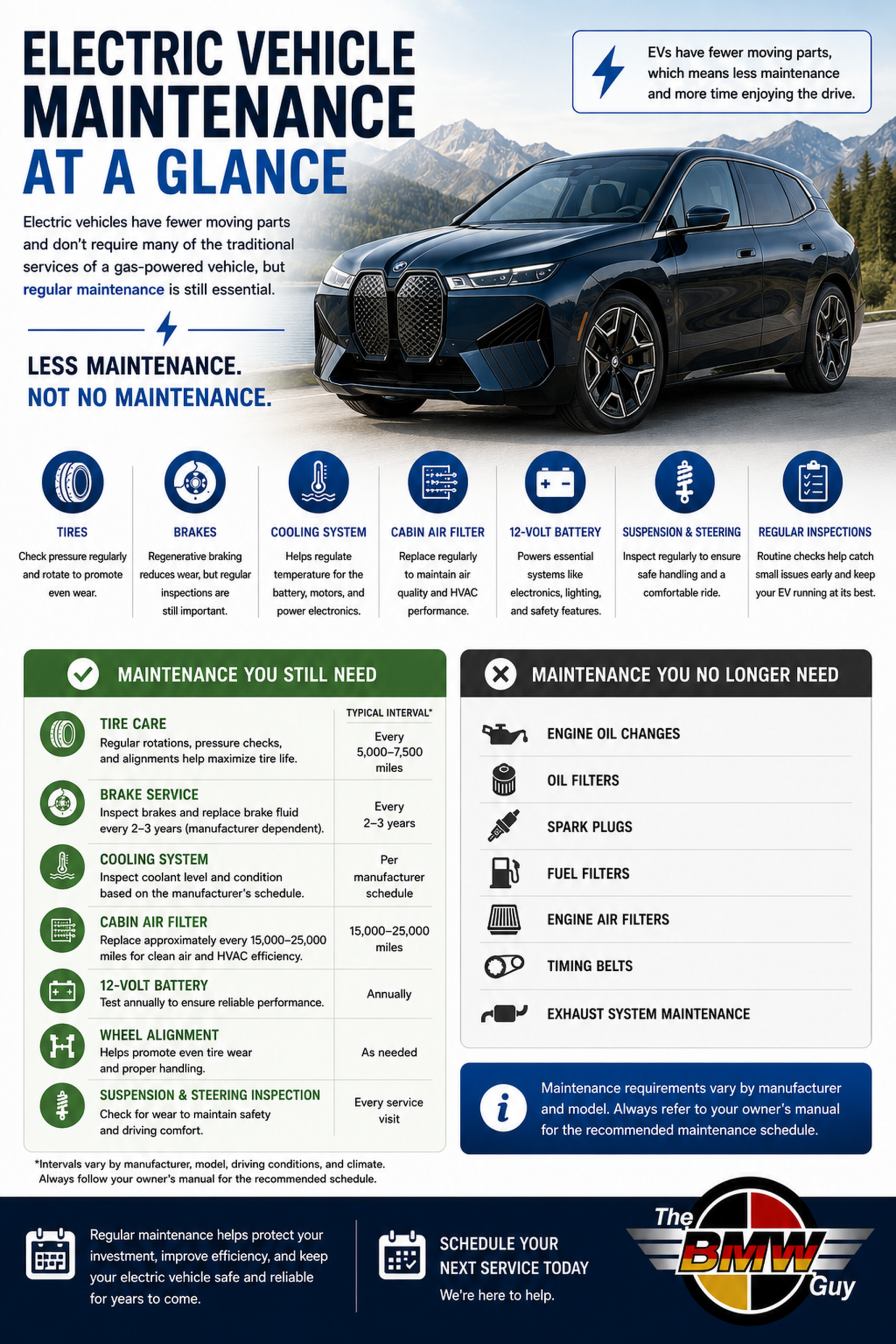
Maintenance You No Longer Need
- Engine oil changes
- Oil filters
- Spark plugs
- Fuel filters
- Engine air filters
- Timing belts
- Exhaust system maintenance
Although these traditional maintenance items have been eliminated, every electric vehicle still benefits from scheduled maintenance and regular inspections to maximize safety, reliability, and long-term performance.
Electric Vehicle Maintenance Schedule
| Maintenance Item | Typical Interval* | Why It Matters |
| Tire Rotation | Every 5,000–7,500 miles | Promotes even tire wear and helps maximize tire life. |
| Tire Pressure Check | Monthly | Improves safety, efficiency, and tire longevity. |
| Brake Inspection | Every service visit | Identifies uneven wear, corrosion, and sticking brake components. |
| Brake Fluid Service | Every 2–3 years (manufacturer dependent) | Brake fluid naturally absorbs moisture over time and should be replaced periodically. |
| Cooling System Inspection | Per manufacturer’s maintenance schedule | Helps protect the battery, electric motors, and power electronics. |
| Cabin Air Filter Replacement | Approximately 15,000–25,000 miles | Maintains cabin air quality and HVAC performance. |
| 12-Volt Battery Test | Annually or during scheduled maintenance | Confirms the health of the battery that powers many essential vehicle systems. |
| Wheel Alignment | As needed | Helps maximize tire life and maintain proper handling. |
| Suspension & Steering Inspection | Every service visit | Detects worn components before they affect handling or accelerate tire wear. |
*Maintenance intervals vary by manufacturer, model, driving conditions, and climate. Always follow your owner’s manual for the recommended maintenance schedule.
Although the high-voltage battery receives most of the attention, it’s rarely the first component that requires significant service. For most owners, scheduled maintenance consists of caring for the same everyday wear items found on nearly every modern vehicle.
The maintenance schedule above provides a general overview, but service intervals can vary depending on the manufacturer, vehicle model, driving conditions, and climate. Following your owner’s maintenance schedule and performing regular inspections helps maximize the safety, reliability, and long-term performance of your electric vehicle.
To learn more about the services we provide, visit our Premium Electric Vehicle Maintenance page.
What Parts of an Electric Vehicle Need Regular Maintenance?
Tires
Electric vehicles often wear through tires faster because they produce instant torque and typically weigh more than comparable gasoline-powered vehicles. Regular tire rotations, maintaining the correct tire pressure, and wheel alignments help maximize tire life.
Brakes
Regenerative braking reduces brake pad wear but doesn’t eliminate brake maintenance. Brake fluid still absorbs moisture over time, and brake components should be inspected regularly for corrosion and proper operation.
Cooling System
Many modern electric vehicles use liquid cooling systems to regulate battery, motor, and power electronics temperatures. Regular inspections help ensure the cooling system continues operating as intended.
12-Volt Battery
Every electric vehicle still relies on a conventional 12-volt battery to power computers, lighting, security systems, and other electronics. Testing it during scheduled maintenance can help prevent unexpected failures.
Wheel Alignment & Regular Inspections
Wheel alignments, suspension inspections, and steering inspections help maximize tire life while maintaining safe handling and ride quality.
Regular inspections also help identify small issues before they become larger, more expensive repairs. While electric vehicles have fewer maintenance requirements than gasoline-powered vehicles, components such as suspension parts, steering components, cooling systems, tires, brakes, and the 12-volt battery still experience normal wear over time.
Following the manufacturer’s recommended inspection schedule helps ensure your vehicle continues operating safely, reliably, and efficiently.
Do Electric Cars Need Oil Changes?
No. Electric vehicles don’t have an internal combustion engine, so they don’t require engine oil changes, oil filters, spark plugs, or fuel filters.
Eliminating these services is one of the reasons electric vehicles generally require less maintenance than gasoline-powered vehicles.
However, “less maintenance” doesn’t mean “maintenance-free.”
Tires, brakes, cooling systems, suspension components, cabin air filters, and the 12-volt battery still require scheduled maintenance and regular inspections to help keep your vehicle operating safely and reliably.
How Long Do Electric Vehicles Last?
One of the most common questions prospective EV owners ask is, “How long do electric vehicles last?”
The answer depends on several factors, including driving habits, climate, charging habits, and how well the vehicle is maintained.
While the high-voltage battery receives most of the attention, long-term reliability depends on much more than the battery alone. Tires, brakes, suspension components, cooling systems, and the 12-volt battery all play an important role in keeping an electric vehicle operating safely and efficiently.
Following the manufacturer’s recommended maintenance schedule, performing regular inspections, and addressing minor concerns early can help maximize the life of your vehicle while reducing the likelihood of unexpected repairs.
Can an Independent Shop Maintain My Electric Vehicle Without Voiding the Warranty?
Yes. Many scheduled maintenance services for electric vehicles are similar to those performed on gasoline-powered vehicles. However, modern EVs also incorporate sophisticated high-voltage systems, advanced cooling systems, and manufacturer-specific maintenance procedures.
Choosing a repair facility that is familiar with electric vehicles helps ensure maintenance is performed according to the manufacturer’s recommendations using the proper procedures, equipment, parts, and fluids.
In most cases, scheduled maintenance can be performed by a qualified independent repair facility without voiding your vehicle’s factory warranty. Under the Magnuson-Moss Warranty Act, manufacturers generally cannot require you to return exclusively to the dealership for scheduled maintenance simply to maintain your warranty, provided the work is performed according to the manufacturer’s recommendations and appropriate parts, fluids, and procedures are used.
Keeping accurate service records is always recommended while your vehicle remains under warranty.
Have Questions About Your Electric Vehicle?
Every electric vehicle is a little different, and maintenance schedules can vary by manufacturer and model.
With more than 20 years of experience specializing in BMW and MINI vehicles, we apply the same manufacturer-focused approach to maintaining today’s electric vehicles.
Whether you drive a BMW i, MINI Cooper Electric, Tesla, Porsche Taycan, Mercedes-Benz EQ, Audi e-tron, or another electric vehicle, our goal is to help you follow the manufacturer’s maintenance recommendations and identify potential concerns before they become costly repairs.
If you’re unsure what maintenance your vehicle needs or when it’s due for service, we’re happy to help.
Contact The BMW Guy to discuss your vehicle’s recommended maintenance schedule or to schedule your next maintenance appointment.
Whether you’re scheduling your first maintenance visit or simply have questions about caring for your electric vehicle, we’re here to help.
Call us:
760-716-4677
Stop by:
1288 W. San Marcos Blvd, San Marcos CA 92078
Shop hours:
Monday – Friday
8am to 5pm
Saturday
9am – 4pm
After hours key drop available 24/7.