
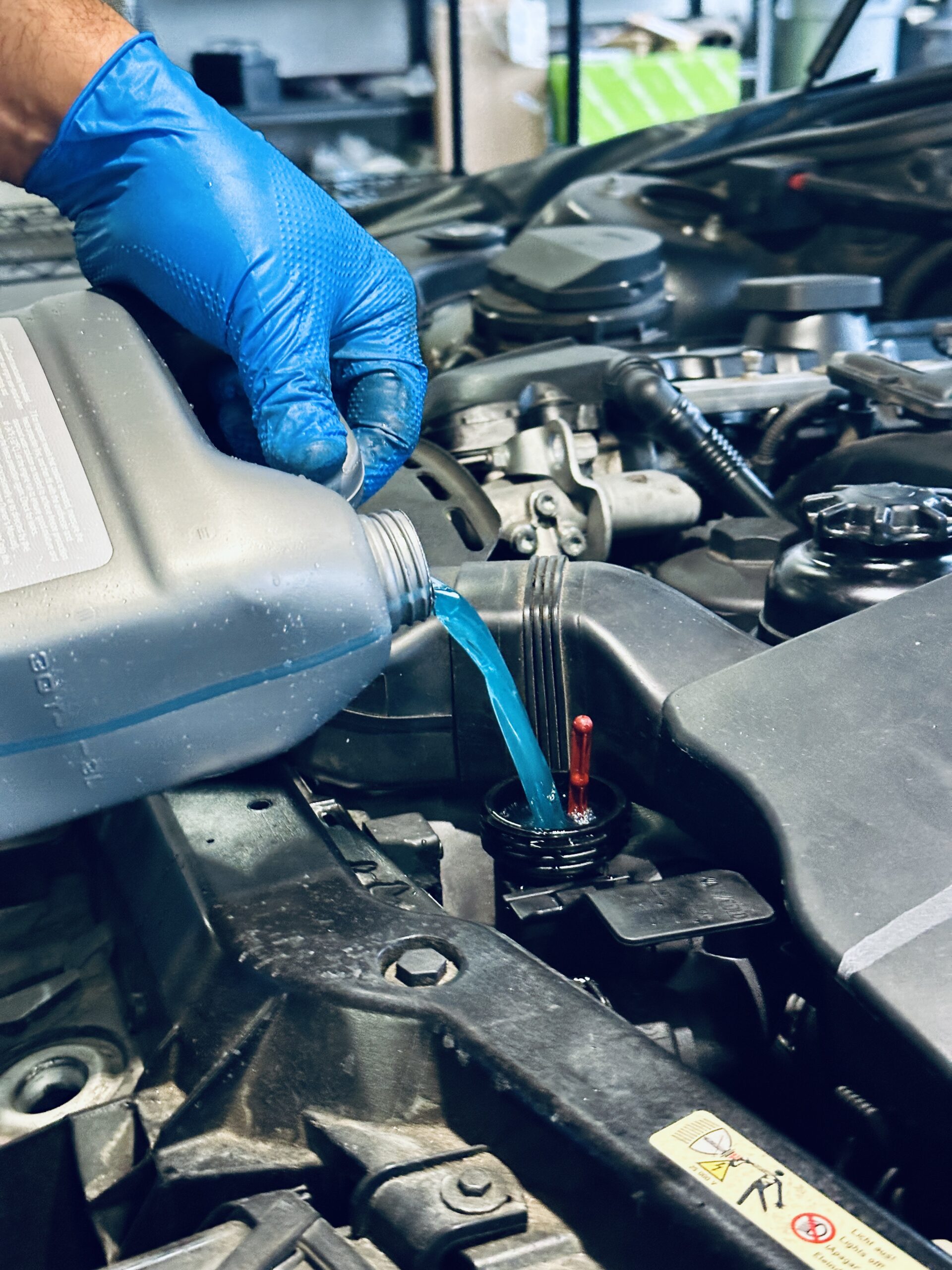
BMW cooling system problems can start with something as simple as a low coolant warning, a strange smell, or a small amount of dried coolant under the hood. At The BMW Guy in San Marcos, we specialize in BMW maintenance, diagnostics, and repair, and coolant leaks are among the problems we regularly diagnose and repair.
In this guide, we’ll explain the basics of engine coolant, warning signs to watch for, common causes of coolant loss, and cooling system problems found on BMW B46 and B48 engines.
1. What Is Engine Coolant and When Should It Be Changed?
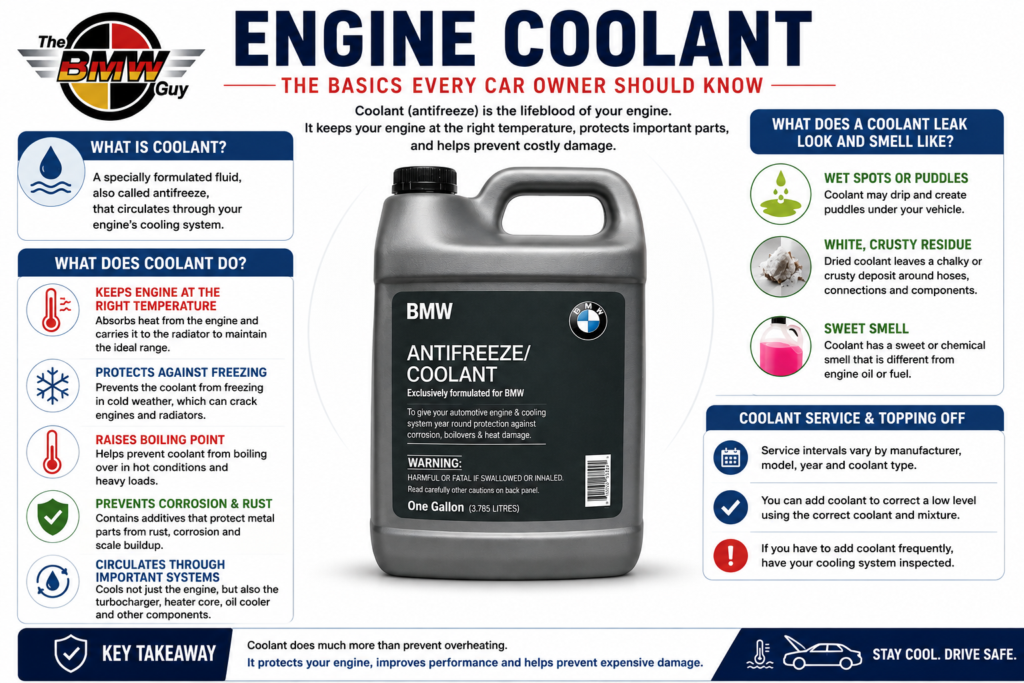
Engine coolant—often called antifreeze—is the fluid that circulates through the engine’s cooling system. Its job isn’t limited to preventing an engine from overheating. Coolant also protects against freezing, raises the boiling point of the fluid, and contains additives designed to protect cooling-system components from corrosion.
What Does Engine Coolant Do?
As an engine runs, it produces heat. Coolant absorbs that heat and carries it through the cooling system so the engine can remain within its intended operating-temperature range.
Modern vehicles can also circulate coolant through components beyond the engine and radiator, including the heater core, turbocharger, oil cooler, and other systems depending on the vehicle.
What Does a Coolant Leak Look and Smell Like?
A coolant leak isn’t always a large puddle underneath the car. You may notice wet areas around cooling-system components, drops underneath the vehicle, or a distinctive sweet or chemical smell.
Another important clue is white, chalky or crusty residue around hoses, connections or other cooling-system components. A small amount of coolant can escape and dry before reaching the ground, leaving deposits behind.
Coolant also comes in different colors. Color alone should not be used to determine which coolant belongs in your vehicle. The correct coolant should be selected according to the manufacturer’s specification.
How Often Should Coolant Be Changed?
There isn’t one coolant-change interval that applies to every vehicle. The appropriate interval depends on the manufacturer, model, model year, coolant specification and maintenance requirements.
Following the correct maintenance requirements helps maintain the coolant’s ability to protect the cooling system.
Can I Add Coolant Between Services?
Yes. If the coolant level needs a minor correction, the proper coolant can be added between services.
The important distinction is between occasionally correcting the coolant level and repeatedly having to add coolant.
If you regularly need to add coolant, the reason for the coolant loss should be investigated.
2. Why Is My Coolant Low, and Can I Still Drive My Car?
A low coolant warning means the vehicle has detected that the coolant level is below its expected range. It doesn’t necessarily tell you why the coolant is low.
The level may simply require a small correction, or the warning could be the first indication of a developing cooling-system problem.
So why is the coolant low? Coolant can be lost through a small leak, an aging hose or connection, or a leaking cooling-system component. If the level keeps dropping after being topped off, there is usually a reason for it and the cooling system should be checked.
What Does a Low Coolant Warning Mean?
A low coolant warning and an engine overheating warning are not the same thing.
If the coolant level is slightly low while the engine is operating normally, there may be time to safely check the level and determine why it dropped.
Always allow the cooling system to cool before opening it. Never open a hot, pressurized cooling system.
Can I Still Drive My Car With Low Coolant?
It depends on how low the coolant is and whether the engine is showing any signs of overheating. If the coolant is only slightly low, the engine temperature is normal, and there are no other warning signs, you may be able to drive a short distance after checking the coolant level.
However, if the warning returns, the coolant level continues to drop, or there are signs of an active leak, the cooling system should be inspected rather than continuing to top it off.
When Should I Stop Driving With Low Coolant?
If the engine temperature is rising, an overheating warning appears, steam is present, or coolant is rapidly escaping, the vehicle should not continue to be driven.
Continuing to operate an overheating engine can turn a cooling-system problem into serious engine damage.
3. Why Am I Losing Coolant if There’s No Visible Leak?
If you’re adding coolant but never see a puddle under the car, it’s easy to wonder where the coolant is going. The important thing to know is that not every coolant leak makes it to the ground.
How Do You Find a Coolant Leak When There’s No Puddle?
Small coolant leaks can be difficult to spot. We look for wet areas, staining, and the white or crusty residue coolant often leaves behind after it dries.
A cooling-system pressure test can also help find a leak that isn’t obvious during a visual inspection. Some leaks only show themselves when the system is hot or under pressure, while others are hidden underneath covers or behind other components.
The important part is finding where the coolant is actually coming from before replacing parts.
Where Is the Coolant Going if There’s No Puddle?
Sometimes coolant leaks onto a hot part of the engine and evaporates before it ever reaches the ground. A small leak may leave nothing behind except a smell, staining, or dried coolant residue.
Coolant can also collect in areas you can’t easily see from above or underneath the car. In some cases, coolant loss can happen internally rather than from an external leak.
That’s why repeatedly adding coolant without seeing a puddle is still a reason to have the cooling system checked.
What Are the Most Common Causes of Coolant Leaks?
Most coolant leaks happen because cooling-system parts age, deteriorate, or become damaged over time.
Some of the most common reasons are:
- Age and heat — Years of heating up and cooling down take a toll on plastic, rubber, hoses and seals.
- Old seals and gaskets — As they age, they can harden and start to seep.
- Brittle plastic — Plastic fittings, connectors and housings can become brittle and crack.
- Aging hoses — Hoses can harden, swell, crack or simply weaken over time.
- Loose or damaged connections — A fitting, clamp or connection can start allowing coolant to escape.
- Pressure problems — A problem controlling cooling-system pressure can contribute to a leak.
- Physical damage — Road debris, previous repairs or accidental damage can damage cooling-system parts.
- A failed component — Water pumps and other cooling-system components can wear out or fail and begin leaking.
Why a coolant leak happens and where it leaks from aren’t always the same thing. On BMWs, there are also certain cooling-system components and engine designs where we see leaks more often—which brings us to the BMW-specific problems next.
4. Are Coolant Leaks Common on BMWs?
Coolant leaks aren’t unique to BMW, but they are something we regularly see as BMWs get older. Modern BMW cooling systems use numerous hoses, connections, seals, pumps and coolant-management components, so there are many possible places for a problem to develop.
At What Age or Mileage Do BMW Coolant Leaks Usually Start?
There isn’t a specific mileage when a BMW will suddenly start leaking coolant. Age can matter just as much as mileage, and driving conditions can make a difference too.
A lower-mileage BMW that’s made thousands of short trips may have experienced far more heating and cooling cycles than the mileage alone suggests. That’s why we look at the vehicle’s age, mileage, service history and actual condition rather than assuming a cooling-system part needs replacement at a certain mileage.
Among the BMWs we service, the B46 and B48 four-cylinder engine family has several cooling-system areas worth understanding as these vehicles get older.
5. Where Are the Most Common Coolant Leaks on BMW B46/B48 Engines?
BMW’s B46 and B48 turbocharged four-cylinder engines are used in many modern BMW models. Like any cooling system, they contain multiple components, seals, hoses and connections that can eventually develop leaks.
Common areas worth inspecting on applicable B46/B48 configurations include:
- Oil filter housing and cooling-system connections
- Coolant hoses and plastic connectors
- Coolant vent lines
- Water pump and associated connections
- Heat-management components
- Expansion tank and associated hoses
- Turbocharger coolant lines and connections, where applicable
The exact failure point shouldn’t be assumed simply because the vehicle has a B46 or B48 engine. The cooling system needs to be inspected to determine where the coolant is actually escaping.
Why Can BMW B46/B48 Engines Develop Multiple Coolant Leaks?
It can be frustrating to fix one coolant leak only to have another one show up somewhere else a few months later. But that doesn’t necessarily mean something went wrong with the first repair.
Most of the cooling-system parts are the same age, but they don’t all fail at the same time. One hose, fitting or seal may fail today while another aging part continues working for another six months or a year.
Fixing one coolant leak fixes that leak—it doesn’t make the rest of the cooling system new.
That’s why when we find a coolant leak on a BMW B46 or B48 engine, we also look at the condition of the surrounding cooling-system components.
6. Which BMW and MINI Models Have the B46/B48 Engine?

The B46 and B48 belong to BMW’s modular turbocharged engine family and are found across numerous BMW and MINI vehicles.
Depending on model year, market and configuration, versions of the B46/B48 engine family can be found in the following BMW and MINI model lines:
| BMW Models | MINI Models |
|---|---|
| 2 Series | MINI Cooper |
| 3 Series | MINI Convertible |
| 4 Series | MINI Clubman |
| 5 Series | MINI Countryman |
| X1 | |
| X2 | |
| X3 | |
| X4 | |
| Z4 | |
| Selected plug-in hybrid models |
Engine applications vary by model year, production date, market and configuration, so the vehicle’s model name alone isn’t always enough to determine whether it has a B46 or B48.
7. How Can I Prevent Coolant Leaks and Cooling System Problems?
You can’t prevent every coolant leak, but you can reduce the chances of a small problem turning into a larger one.
Pay attention to low-coolant warnings, use the correct coolant, follow the appropriate service requirements for your BMW, and don’t ignore a coolant level that keeps dropping. Regular inspections can also catch small leaks before they become more serious.
What Cooling System Maintenance Does My BMW Need?
A few basics make a difference:
- Use the correct coolant specification for your BMW.
- Follow the appropriate coolant service requirements for your model.
- Check coolant level and condition during regular service.
- Inspect hoses, fittings and connections.
- Look for leaks, staining or dried coolant residue.
- Investigate a recurring low-coolant warning rather than continually topping it off.
Fresh coolant is important, but it can’t make an aging hose, seal or plastic component new again.
8. How Much Does a BMW Coolant Leak Cost to Repair?
There isn’t one meaningful answer to “How much does a BMW coolant leak cost?”
A leaking hose or accessible connection may be relatively straightforward to repair. A leaking component that requires significant engine disassembly for access can involve considerably more labor.
The final cost depends on:
- Which component is leaking
- BMW model and engine
- Parts required
- Component accessibility
- Labor required for disassembly and reassembly
- Whether additional damaged or deteriorating components are discovered
This is why diagnosis should come before the repair estimate, rather than trying to price a generic “BMW coolant leak repair.”
Should I Replace Other Cooling System Parts at the Same Time?
Not automatically.
The important questions are whether another part is already leaking or deteriorated, and whether replacing it at the same time provides meaningful labor overlap.
For example, if accessing one cooling-system component requires substantial disassembly and another aging component in the same area is already showing signs of failure, addressing both at once may avoid paying for much of the same labor again later.
If the other components are in good condition and there is little or no labor overlap, replacing them simply because they’re nearby may not make sense.
The decision should be based on the condition of the individual BMW—not a rule that says everything has to be replaced together.
BMW Cooling System Maintenance & Repair in San Marcos, CA
Seeing a low coolant warning doesn’t necessarily mean your BMW has a major problem. But if the coolant level keeps dropping or you’re regularly topping it off, it’s worth finding out where the coolant is going.
This is especially true on BMW B46 and B48 engines, where there are several different places a coolant leak can develop. Knowing the common problem areas helps, but we still believe in finding the actual leak before recommending a repair.
At The BMW Guy in San Marcos, we work on BMW cooling systems every day—from routine coolant maintenance and small leaks to more involved cooling-system repairs. B46 and B48 engines are just some of the BMW engines we regularly service. Our goal is simple: figure out what’s wrong, explain what we find, and recommend what your BMW actually needs.
We serve BMW owners throughout North County San Diego, including Oceanside, Vista, Carlsbad, Poway, Rancho Bernardo, San Elijo Hills, and surrounding communities.