
In our Car Maintenance Checklist, we talked about all the different things that go into keeping a car maintained. Oil changes, fluids, filters, brakes, tires—the list can get pretty long.
But there’s one important part of car maintenance that’s really easy to forget about:
Your wheel alignment.
There’s no filter to replace. No fluid to change. And your car usually doesn’t pop up with a message saying, “Hey, it’s time for an alignment.”
So it’s easy to forget about it until something doesn’t feel right—or you look at your tires and realize one of them is wearing very differently from the others.
But here’s the tricky part:
Your alignment can be off even when the car seems to drive perfectly fine.
So, how do you know if you need an alignment? How often should you check it? And what exactly are we even “aligning”?
First, What Is a Wheel Alignment?
Let’s forget the technical terminology for a minute.
Think about the four wheels on your car.
Ideally, they should all be sitting and pointing in the direction the vehicle manufacturer intended. If one or more wheels is pointing slightly too far inward, outward, or leaning at the wrong angle, the car is out of alignment.
And we’re talking about very small differences here. Your wheel doesn’t have to look obviously crooked for the alignment to be off.
A wheel alignment is simply measuring those angles and, when possible and necessary, adjusting them back to the correct specifications.
That’s really it.
You may hear us talk about toe, camber, and caster. Those are just names for the different angles we’re measuring.
Toe is basically whether the wheels are pointing slightly toward or away from each other.
Camber is how much the wheel leans inward or outward when you look at the car from the front.
Caster has more to do with the angle of the steering and suspension and how the car tracks and returns to center.
You don’t need to memorize any of that.
The important thing to understand is that an alignment isn’t adjusting your tires—it’s measuring and adjusting the position of the wheels through the vehicle’s steering and suspension.
How Do I Know If I Need an Alignment?
Sometimes your car makes it pretty obvious.
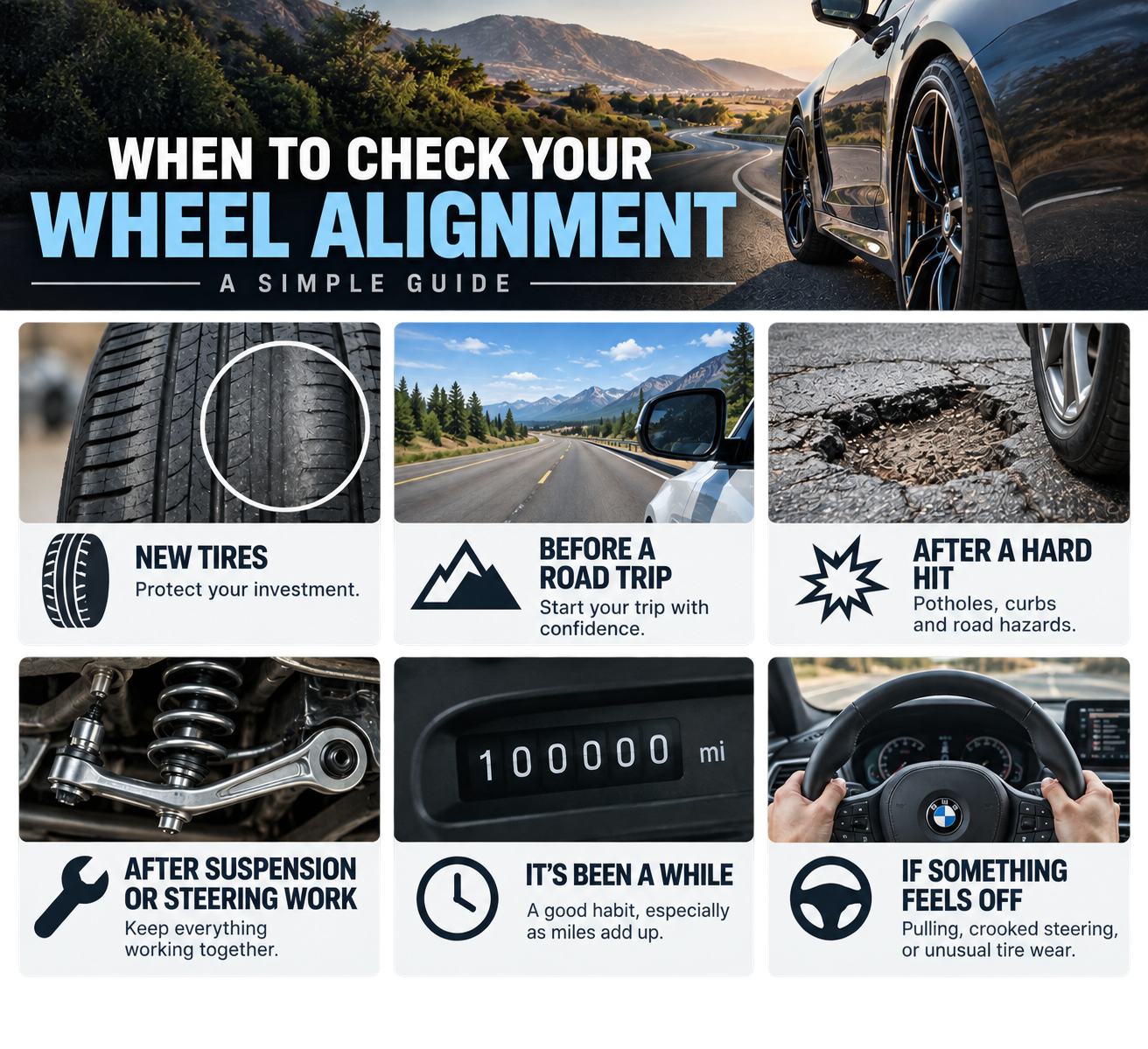
You might notice the steering wheel sitting crooked even though the car is going straight.
Maybe the car seems to pull or drift to one side.
Or you look at your tires and notice the inside or outside edge is wearing much faster than the rest of the tread.
Those are all good reasons to have the alignment checked. A hard pothole or curb strike can also knock things out of alignment.
But this is where alignment gets a little different from other car problems:
You may not feel anything at all.
The car can drive straight. The steering wheel can look straight. Everything can feel completely normal—and the alignment can still be outside the manufacturer’s specifications.
You may not discover it until you notice an unusual wear pattern developing on the tires.
And by then, part of the tire life you’ve already paid for is gone.
When Should I Have My Alignment Checked?
There isn’t one exact mileage when every car needs an alignment.
Instead, think about the times when it makes sense to check it before there’s an obvious problem.
One of the best habits is to check your alignment whenever you install a new set of tires.
New tires don’t automatically mean your car needs an alignment. But you just spent money on a fresh set of tires, so it makes sense to make sure everything is aligned correctly before you start putting miles on them.
If the alignment is good, great—nothing needs to be adjusted.
If it’s off, you can correct it before it starts wearing your new tires unevenly.
It can also be worth checking before a long road trip, especially if it’s been a while since the alignment was last checked. If you’re about to put hundreds or thousands of miles on the car, it’s better to find an alignment or tire-wear problem before the trip than after.
And if you’ve recently had certain steering or suspension repairs, that’s another good time to check it.
If it’s simply been a long time since anyone has checked the alignment, there’s nothing wrong with having it measured—especially as the car gets older and accumulates more miles.
Checking the alignment doesn’t mean you automatically need an alignment. It just tells you where things stand.
Do I Need an Alignment When I Get New Tires?
Not always. New tires don’t automatically mean you need an alignment.
But it’s a really good time to check it.
Think about it—you just spent money on a brand-new set of tires. You probably want to get as much life out of them as possible. Checking the alignment makes sure you’re not starting out with a problem that could begin wearing those new tires unevenly.
If the alignment is good, great. If it’s off, you can correct it before the new tires start wearing.
Can Bad Alignment Ruin My Tires?
Yes, and this is where alignment can get expensive.
If a wheel is slightly out of alignment, one part of the tire can wear much faster than the rest. And you may not even notice it while driving.
We’ve seen tires that look perfectly fine from the outside, but the inside edge is already badly worn.
By the time you notice it, the damage to the tire is already done. Fixing the alignment can prevent more uneven wear, but it can’t put the tread back on the tire.
That’s one of the biggest reasons it’s worth catching an alignment problem early.
Can a Pothole Knock My Car Out of Alignment?
Yes. A hard enough pothole hit can knock your car out of alignment. The same goes for hitting a curb or another hard impact to the wheel.
That doesn’t mean you need an alignment every time you hit a pothole. We’d all be getting alignments every week if that were the case.
But if you hit one hard enough that you immediately think, “That didn’t sound good,” pay attention to how the car feels afterward.
Does it pull differently? Is the steering wheel no longer straight? Did you suddenly notice a vibration or something else that wasn’t there before?
If so, it’s worth having it checked.
And remember, a hard impact can do more than change the alignment. It can also damage a tire, bend a wheel, or damage a steering or suspension component. So sometimes what feels like an alignment problem is actually something else that needs to be inspected.
Why Is My Car Vibrating or Shaking?
If your car is vibrating or your steering wheel starts shaking, you might wonder if you need an alignment.
Usually, vibration is caused by something else.
It could be something as simple as a wheel that needs balancing, or it could be a damaged or unevenly worn tire, a bent wheel, worn steering or suspension parts, or even a drivetrain problem. If you mainly notice the vibration when you step on the brakes, the braking system could be the cause.
And this is where alignment and wheel balancing often get confused. An alignment deals with how your wheels are positioned. Balancing deals with how smoothly the wheel and tire spin.
So if your car is shaking, an alignment may not be the answer. The first step is figuring out what’s actually causing the vibration.
What Happens If I Don’t Get an Alignment?
If your alignment is off, it usually won’t get better on its own.
You may continue wearing your tires unevenly, the car may not drive or handle the way it should, and a small problem can eventually become an expensive set of tires.
That’s really the reason to pay attention to alignment: it helps your tires last longer and keeps your car driving the way it was designed to.
You don’t need to constantly worry about your alignment. As we mentioned earlier, check your alignment when it makes sense—and if something starts to feel off, don’t ignore it.
Then we can move into “Why Can’t My Car Be Aligned?” without repeating everything we’ve already covered.
Why Can’t My Car Be Aligned?
Sometimes you bring your car in for an alignment, but something else is preventing it from being aligned properly.
A worn suspension or steering part can allow the wheel to move around instead of staying where it should. Something may also be bent from a pothole, curb hit, or previous accident.
Lowered or modified cars can be another story. Changing the ride height can change the wheel angles enough that the factory adjustments simply aren’t enough to bring everything back where it should be.
So if your car won’t align properly, doing the alignment over and over isn’t the answer. We first need to figure out what’s keeping it from being aligned and fix that problem.
Is Wheel Alignment the Same for Every Car?
The basic idea is the same: measure the position of the wheels and make sure they’re within the manufacturer’s specifications.
But the actual alignment isn’t the same for every vehicle.
Different cars have different specifications, different suspension designs, and different adjustments available. Some vehicles allow adjustments at all four wheels, while others have fewer factory adjustments.
EVs and hybrids need alignments too. They still have tires, wheels, steering, and suspension just like a gas-powered car. And because some EVs are relatively heavy and can put a lot of torque through the tires, keeping an eye on tire wear and alignment can be especially worthwhile.
Some newer vehicles can also require additional procedures after an alignment, depending on the steering, suspension, and driver-assistance systems they use.
So while the idea behind an alignment is the same, how it’s performed—and what needs to be checked—depends on the vehicle.
The Bottom Line on Wheel Alignments
Wheel alignment is pretty simple when you get down to it.
Your wheels should be pointing where they’re supposed to be. When they aren’t, your tires can wear faster and your car may not drive the way it should.
The difficult part is that you won’t always know when the alignment is off. That’s why it’s worth checking from time to time instead of waiting until a tire is already worn out.
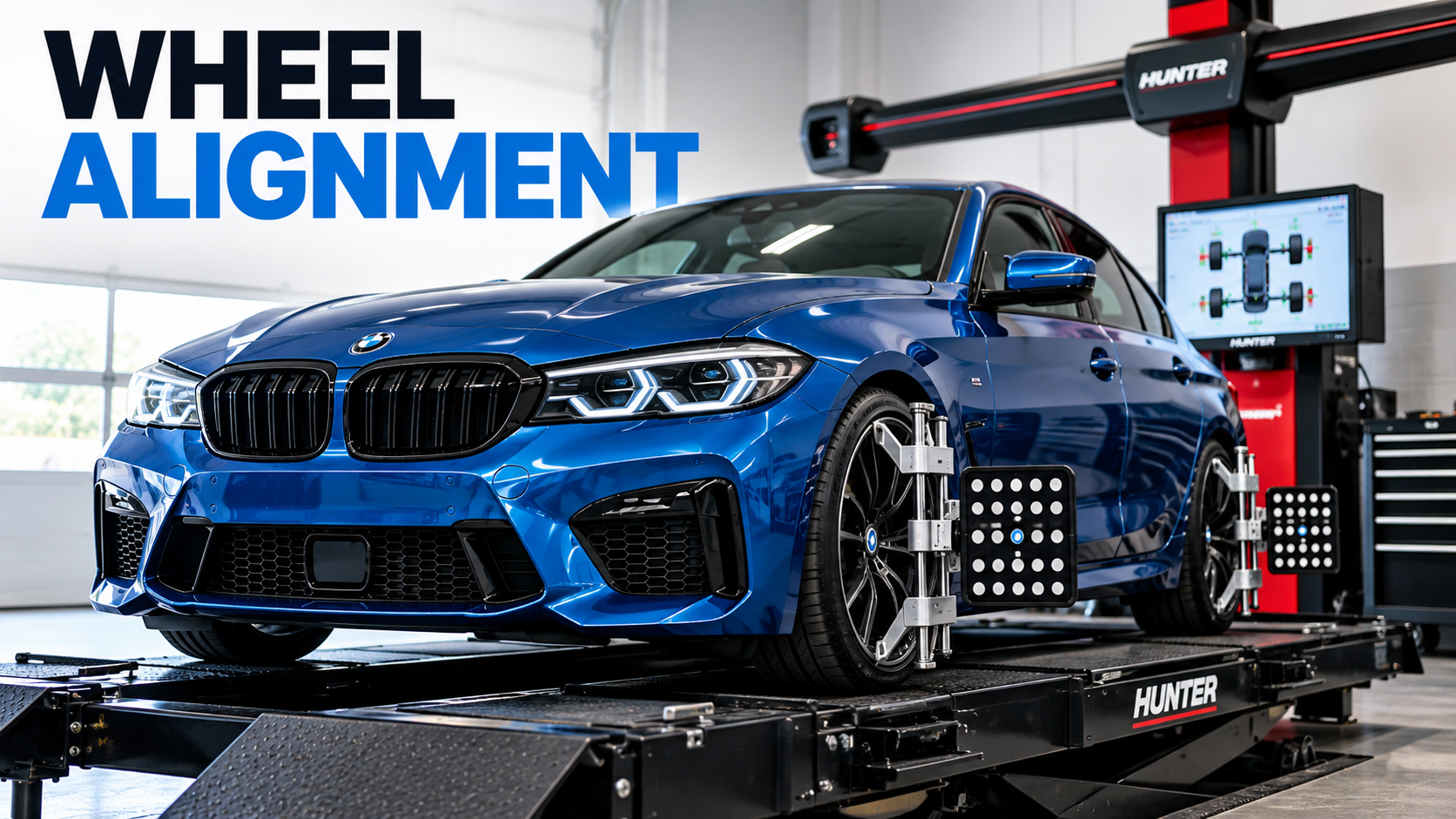
At The BMW Guy, we use Hunter alignment equipment to measure your alignment accurately. If everything looks good, we’ll tell you. If something is off, we can figure out whether it simply needs an adjustment or whether there’s another problem that needs attention first.
Ready to Schedule?
Have a question or want to make an appointment? Get in touch with The BMW Guy.
Book online:
Choose a convenient day and time and book your appointment directly through our website.
Call us:
760-716-4677
Stop by:
1288 W. San Marcos Blvd, San Marcos, CA 92078
Shop hours:
Monday – Friday: 8am – 5pm
Saturday: 9am – 4pm
After-hours key drop available 24/7.
We serve San Marcos, Oceanside, Vista, Carlsbad, Escondido, Poway, Rancho Bernardo, San Elijo Hills, and communities throughout North County San Diego.